On-Grid vs Off-Grid vs Hybrid Solar System: What’s the Difference?
Sep 23, 2026

As solar energy and battery storage become more popular, choosing the right battery technology is an important part of designing a reliable energy system. One battery chemistry that has gained significant attention in solar and energy-storage applications is LFP, or Lithium Iron Phosphate.
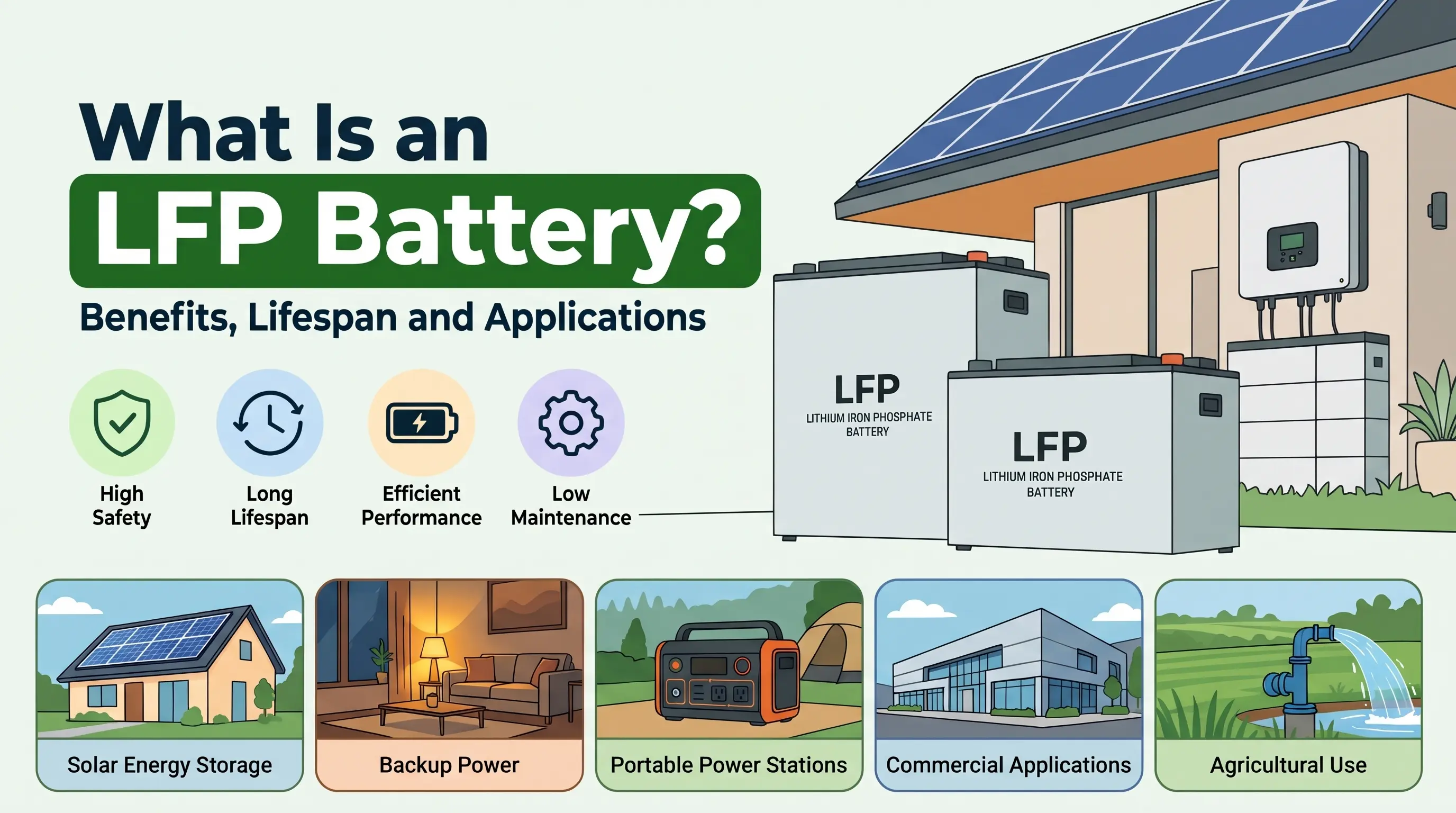
LFP batteries are known for their combination of safety characteristics, long cycle life, stable performance, and suitability for repeated charging and discharging. They are widely used in solar energy storage, backup power systems, portable power stations, electric vehicles, and other energy-storage applications.
In this guide, we explain what an LFP battery is, how it works, its main benefits, expected lifespan, and where it is commonly used.
LFP battery stands for Lithium Iron Phosphate battery. It is a type of lithium-ion battery that uses lithium iron phosphate as the cathode material.
Compared with some other lithium-ion chemistries, LFP technology is known for its relatively stable chemical and thermal characteristics. This makes it particularly suitable for applications where safety, durability, and frequent cycling are important.
An LFP battery typically consists of:
The BMS plays an important role by monitoring and managing parameters such as voltage, current, temperature, charging, and discharging.
When an LFP battery is being charged, electrical energy from a source such as a solar inverter or charger is stored as chemical energy inside the battery.
When electricity is required, the battery releases the stored energy and supplies electrical power to the connected system.
In a solar energy system, the basic energy flow can look like:
Solar Panels → Solar Inverter → Loads
When there is excess solar energy:
Solar Panels → Solar Inverter → LFP Battery
When solar generation is insufficient:
LFP Battery → Inverter → Electrical Loads
This allows stored solar energy to be used later, including during the evening or during a power interruption.
One of the biggest advantages of LFP batteries is their ability to withstand repeated charging and discharging.
When properly designed and operated, an LFP battery can provide a large number of charge-discharge cycles. Actual lifespan depends on factors such as depth of discharge, operating temperature, charging conditions, battery quality, and usage patterns.
This makes LFP technology particularly attractive for solar energy storage, where batteries may be cycled regularly.
LFP chemistry has relatively strong thermal and chemical stability compared with some other lithium-ion chemistries.
This can reduce certain risks associated with overheating and thermal instability when the battery is properly designed, manufactured, installed, and protected.
However, like all rechargeable batteries, LFP batteries still require appropriate protection, installation, ventilation where applicable, and a properly configured BMS.
LFP batteries can provide efficient energy storage and delivery, helping reduce energy losses during repeated charging and discharging.
Higher usable efficiency can be particularly valuable in solar systems because stored electricity may be used multiple times throughout the life of the battery.
Solar battery systems often charge during periods of solar generation and discharge when energy is needed.
Because LFP batteries are well suited to repeated cycling, they are commonly used in applications where regular battery operation is expected.
Compared with traditional lead-acid battery systems, LFP batteries generally require less routine maintenance.
There is no need for regular electrolyte maintenance in a sealed LFP battery system, although the battery, connections, BMS, and overall installation should still be inspected according to the manufacturer's recommendations.
LFP batteries can provide consistent performance across many charging and discharging cycles when operated within their specified conditions.
Their stable characteristics make them suitable for both residential and commercial energy-storage applications.
The lifespan of an LFP battery depends on several factors rather than being determined by a single fixed number.
Important factors include:
A quality LFP battery used under appropriate operating conditions can generally provide thousands of charge-discharge cycles.
For example, a battery used with moderate daily cycling may have a significantly different service life from one that is repeatedly discharged to very low levels under high temperatures.
Therefore, when comparing batteries, it is important to look beyond the advertised cycle count and consider the manufacturer's warranty, recommended operating conditions, usable capacity, BMS specifications, and installation requirements.
LFP batteries and lead-acid batteries are both used for energy storage, but they have different characteristics.
| Feature | LFP Battery | Lead-Acid Battery |
|---|---|---|
| Cycle life | Generally longer | Generally shorter |
| Energy efficiency | Generally higher | Generally lower |
| Weight | Generally lighter | Generally heavier |
| Maintenance | Low | Can be higher depending on type |
| Usable capacity | Generally higher | Often lower for long service life |
| Charging speed | Generally faster | Generally slower |
| Frequent cycling | Well suited | More limited depending on battery type |
| Initial cost | Usually higher | Usually lower |
| Long-term value | Can be attractive for frequent cycling | Can be suitable for lower-cost applications |
The right choice depends on the application, budget, required backup duration, operating conditions, and expected usage pattern.
Solar energy production varies throughout the day. Solar panels typically generate the most electricity when sunlight is available, while electricity demand may continue into the evening.
An LFP battery can store excess solar energy during periods of high solar generation and make that energy available later.
For example:
Daytime:
Solar panels generate electricity → Household loads use power → Excess energy charges the LFP battery.
Evening:
Solar generation decreases → LFP battery supplies stored energy → Household loads continue operating.
This can help increase the use of locally generated solar energy and reduce dependence on grid electricity, depending on the system configuration.
LFP batteries can also be used as part of a backup power system.
During normal operation, the battery can be charged from solar energy or another compatible power source. During a grid outage, the inverter can use stored battery energy to supply designated backup loads.
This can be useful for:
The required battery size depends on the power consumption of the connected equipment and how long backup power is required.
LFP batteries are used across a wide range of applications.
LFP batteries are widely used with residential and commercial solar systems for storing excess solar energy.
They can provide stored energy during electricity interruptions when integrated with a compatible inverter.
LFP technology is increasingly used in portable power stations because of its cycle life and durability.
Businesses can use battery storage for backup power, energy management, and other applications depending on local electricity regulations and system design.
Solar-plus-storage systems can support agricultural equipment, irrigation systems, lighting, monitoring equipment, and other electrical loads.
LFP batteries are also used in various electric vehicles and mobility applications where their characteristics are suitable.
The Battery Management System (BMS) is an important part of a modern LFP battery.
The BMS helps monitor and manage the battery by tracking parameters such as:
Depending on the battery design, the BMS can provide protection against conditions such as overcharging, excessive discharge, excessive current, and abnormal temperature.
A good battery system should therefore be evaluated as a complete package rather than based only on the battery cells.
Before purchasing an LFP battery for a solar or backup system, consider the following factors:
Capacity is commonly expressed in kWh or Ah. Select a capacity appropriate for your energy consumption and required backup duration.
Make sure the battery voltage is compatible with your solar inverter. Common configurations include 24V, 48V, and other system voltages.
The total rated capacity is not always the same as the energy that should routinely be used. Check the manufacturer's recommended depth of discharge.
The battery must be capable of handling the required charging and load demand.
Check the BMS protection functions and communication compatibility with your inverter.
Temperature can affect battery performance and lifespan. Always operate the battery within the manufacturer's specified temperature range.
Consider the manufacturer's warranty, technical support, expected cycle life, and product specifications before making a purchase.
Ensure that the battery can communicate and operate correctly with the selected inverter, particularly when using advanced battery-management functions.
The growing adoption of LFP batteries in solar energy storage is largely driven by their combination of long cycle life, safety characteristics, efficiency, and suitability for repeated cycling.
For homeowners and businesses that regularly charge and discharge their batteries, these characteristics can make LFP technology an attractive long-term energy-storage option.
However, battery performance depends heavily on system design and operating conditions. Correct sizing, compatible equipment, proper installation, and appropriate battery management are essential for achieving reliable performance.
LFP, or Lithium Iron Phosphate, is an important battery technology for modern energy-storage applications.
Its combination of long cycle life, stable characteristics, efficiency, low maintenance requirements, and suitability for frequent cycling makes it particularly useful for solar energy storage and backup power systems.
When selecting an LFP battery, don't focus only on price or capacity. Consider the complete system—including battery voltage, usable capacity, cycle life, BMS, charging and discharging current, inverter compatibility, warranty, and operating conditions.
At MMSL Power, we provide energy-storage solutions designed for residential and commercial applications. Choosing the right LFP battery and pairing it with a compatible inverter can help create a more reliable and efficient solar energy system.
Your email address will not be published. Required fields are marked *