On-Grid vs Off-Grid vs Hybrid Solar System: What’s the Difference?
Sep 23, 2026

Solar energy has become an increasingly practical solution for homes, businesses, farms, and commercial facilities looking to reduce dependence on conventional electricity. However, choosing a solar system is not simply about selecting solar panels. One of the most important decisions is choosing the right solar system configuration.
The three most common configurations are on-grid, off-grid, and hybrid solar systems. Although all three use solar energy, they differ significantly in how they interact with the electricity grid, batteries, and backup power sources.
In this guide, we explain the differences between on-grid, off-grid, and hybrid solar systems and help you understand which type may be suitable for different applications.
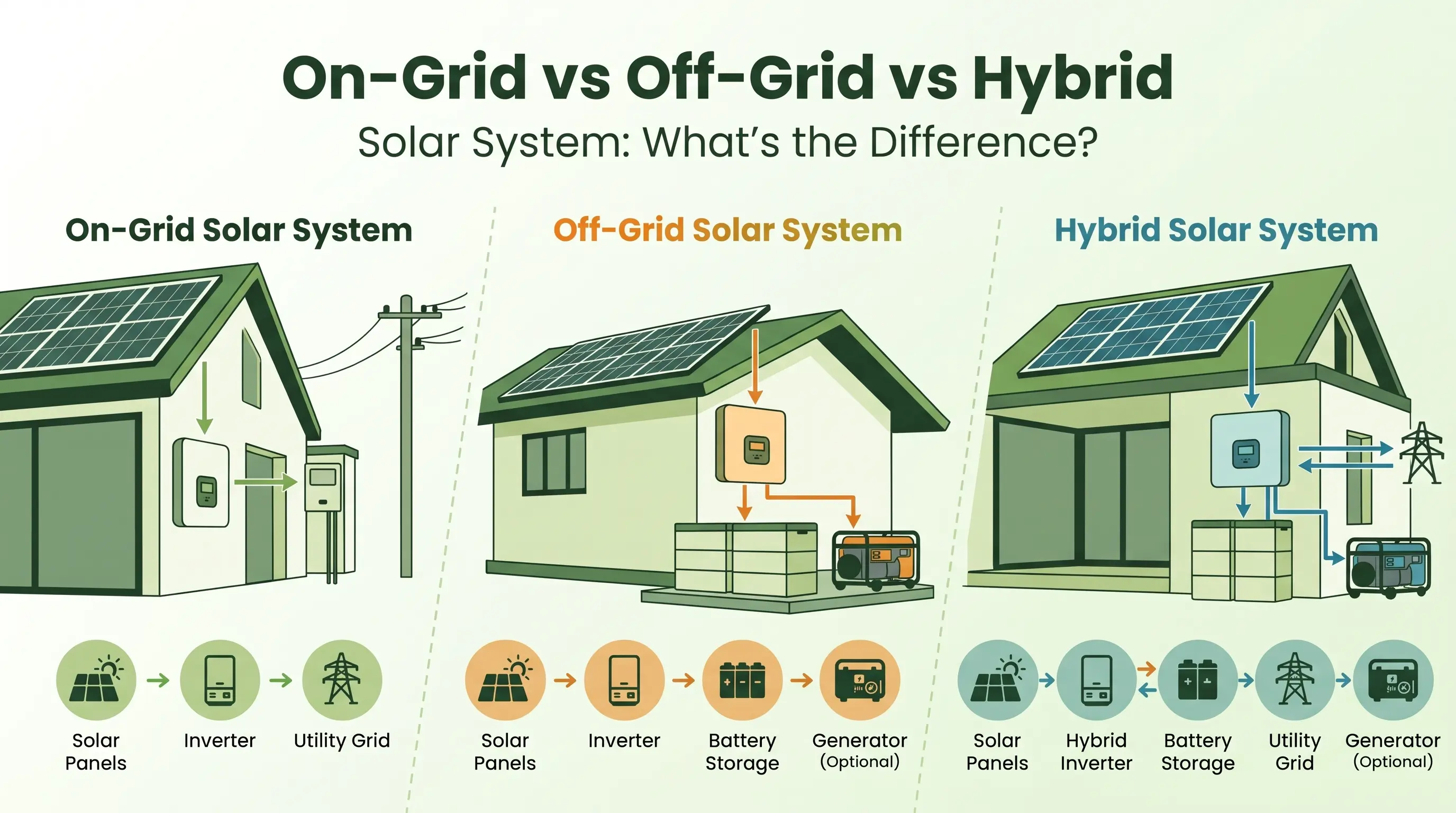
An on-grid solar system, also known as a grid-tied solar system, is connected directly to the utility electricity grid.
During the day, solar panels generate electricity. A grid-connected inverter converts the electricity into usable AC power for household or business appliances. Solar energy is generally used first by the connected loads, while excess electricity may be exported to the grid where the applicable electricity regulations and net-metering arrangements allow it.
When solar production is insufficient, electricity can be supplied from the utility grid.
A typical on-grid system consists of:
Unlike an off-grid system, a conventional on-grid solar system normally does not require a large battery bank.
One important limitation is that a conventional grid-tied system generally cannot continue supplying power during a grid outage unless it has specifically designed backup capability.
Therefore, if uninterrupted power during load shedding or grid failure is a major requirement, a battery-based hybrid system may be more appropriate.
An off-grid solar system operates independently of the utility electricity grid.
Solar panels generate electricity, while batteries store excess energy for use when sunlight is unavailable. Depending on the system design, a generator may also be included as an additional backup source.
Off-grid systems are particularly useful in locations where grid electricity is unavailable, unreliable, or impractical to connect.
A typical off-grid system includes:
During daylight hours, solar energy can supply the loads and charge the batteries. At night or during periods of insufficient solar generation, stored battery energy can supply the loads.
Off-grid systems require sufficient battery capacity and solar generation to meet the required energy demand. As a result, the initial investment can be higher than a basic grid-connected system.
The system must also be properly sized according to daily energy consumption, peak loads, battery capacity, solar availability, and required backup duration.
A hybrid solar system combines solar panels, battery storage, and grid electricity in one integrated energy-management system.
Depending on the inverter and system configuration, a hybrid system can use solar energy, charge batteries, draw electricity from the grid, and provide backup power when the grid is unavailable.
Some hybrid systems can also integrate a generator.
During the day, solar energy can be used to power appliances. Excess solar energy can charge the battery.
When solar generation is insufficient, the system can use stored battery energy or electricity from the grid, depending on the programmed operating mode.
During a grid outage, the inverter can switch the designated backup loads to battery or solar power.
Hybrid systems are generally more complex and can cost more than basic on-grid systems because they include battery storage and additional energy-management functions.
However, for users who need both solar savings and backup power, the additional functionality can be valuable.
The main differences can be summarized as follows:
| Feature | On-Grid | Off-Grid | Hybrid |
|---|---|---|---|
| Utility grid connection | Yes | No | Yes |
| Solar panels | Yes | Yes | Yes |
| Battery required | Usually no | Yes | Usually yes |
| Backup during grid outage | Generally no | Yes | Yes |
| Generator integration | Usually not required | Possible | Possible |
| Energy independence | Low | High | Medium–High |
| Initial investment | Generally lower | Generally higher | Generally higher |
| Suitable for remote locations | Limited | Yes | Sometimes |
| Energy management | Basic | Advanced | Advanced |
| Battery charging/storage | Optional | Essential | Integrated |
The best system depends on your electricity requirements, grid availability, budget, and need for backup power.
An on-grid system may be suitable if:
An off-grid system may be appropriate if:
A hybrid system may be suitable if:
For hybrid and off-grid systems, battery capacity is one of the most important design considerations.
A battery should not simply be selected according to inverter power. The required capacity depends on factors such as:
For example, a household that needs only a few hours of backup will have different battery requirements from a business that needs essential equipment to operate throughout a prolonged power outage.
LFP (Lithium Iron Phosphate) batteries are increasingly used in modern energy-storage systems because of their combination of cycle life, safety characteristics, efficiency, and suitability for repeated charging and discharging.
The inverter is one of the most important components of a hybrid solar system.
A modern hybrid inverter can manage several energy sources, including:
Solar → Loads → Battery → Grid → Generator
Depending on the system configuration, the inverter determines how energy is distributed and when batteries should be charged or discharged.
For example, MMSL Power offers hybrid inverter solutions such as the Growatt SPE series for single-phase applications and the Growatt WIT series for higher-capacity three-phase applications.
The appropriate inverter should be selected based on:
Another important consideration is whether your property uses a single-phase or three-phase electrical connection.
Single-phase hybrid inverters are commonly used for houses and smaller installations.
Three-phase hybrid inverters are more suitable for larger homes, commercial buildings, farms, workshops, and other applications with three-phase loads.
For larger installations, three-phase systems can provide better compatibility with three-phase equipment and allow more flexible distribution of electrical loads.
Before purchasing a solar system, consider the following:
Review your monthly electricity bills and identify your average and peak consumption.
Determine which appliances or equipment must continue operating during a power outage.
The available roof or ground area affects the number of solar panels that can be installed.
Determine how many hours of backup you need and size the battery accordingly.
Choose an inverter that can handle your required continuous and peak loads.
If you expect your electricity consumption to increase, consider an expandable system from the beginning.
Solar systems should be properly designed and installed with appropriate electrical protection, grounding, isolation, and wiring.
On-grid, off-grid, and hybrid solar systems each serve different purposes.
An on-grid system is primarily designed to work alongside the utility grid and can be a practical option for reducing daytime electricity consumption.
An off-grid system is designed for energy independence and relies on solar generation and battery storage rather than the utility grid.
A hybrid system combines solar, battery storage, and grid electricity to provide greater flexibility and can provide backup power during grid interruptions when properly configured.
The right choice depends on your energy consumption, grid reliability, backup requirements, budget, available installation space, and future energy needs.
At MMSL Power, we provide solar inverters, battery solutions, and energy-storage products for different residential and commercial requirements. A properly designed system can help you make better use of solar energy while improving power availability and energy management.
Your email address will not be published. Required fields are marked *